Irish software at Oracle OpenWorld 2010


Preparation for the trio of Oracle’s major conferences (Oracle OpenWorld, JavaOne, Oracle Develop) has been underway for months, but once September comes around the pace really quickens. The final touches get put to product demonstration scripts, keynote speeches, and honing the elevator pitch. In product development you know it’s September because you can not find a product manager without scheduling a meeting days in advance. Of course, this is not unique to Oracle. There will be over 300 exhibitors at Oracle OpenWorld and many of them will be making sure their product or service is presented in the best possible manner. Having announced a major certification over the summer with Oracle’s Global License Management Services, the staff at one Irish software company will be no different.

iQuate is an Irish software company which produces network inventory and network management solutions for large, complex networks. Using a multitude of protocols iQuate queries PCs, servers, network devices, databases to not only build up a profile of what is installed, but also what is actually being used. This information allows companies to potentially save a fortune on their software licencing fees, by simply not paying for what they are not using. Check them out at stand 3130 in the Moscone Center, West Exhibition Hall, Level 1.

Come to thing of it, Oracle has development centres around the world and the Dublin offices have staff working on server technology, tools and application software. So some portions of the Oracle software on show will have been made in Ireland too! 🙂

Is iQuate really the only Irish software company exhibiting? It is the only one on the list of exhibitors with an Irish HQ. There might be other software companies that originated in or do the majority of their development in Ireland but have not listed an Irish address as their headquarters when registering as an exhibitor. In an effort to get into the US market and not appear as a foreign company, some businesses move their HQ to the US. This also demonstrates their commitment to the market. If you know of any other Irish software companies exhibiting this year please let me know and I would be delighted to include them.

Loosely typed interfaces – The Normalizer Pattern and Oracle SOA Suite

When getting two or more systems working together, the making a connection part is generally the easiest, identity propagation is a bit trickier, but many times, the syntax and semantics of one system is at odds with another one. Over the decades this has been manifest in many ways and thankfully there are tools and techniques to work through them. A collation of such techniques is Enterprise Integration Patterns. The book, along with the associated website, is worthy of a dedicated article or two, and is not the real subject of this article. One message transformation pattern the book describes is the Normalizer Pattern where different formats for essentially the same object are catered for.
An example where this form of message translation becomes necessary is when using a service with a loosely typed interface. This can often happen when an existing system or utility (such as a batch / command processor) gets exposed as a web service. The request / response payload is little more than a collection of key / value pairs. There are a couple of ways to cater for this using Oracle SOA Suite 11g which I will outline in this article. One has full tool support. The other, a solution using XSLT, is not fully supported, but has an advantage in that the XSLT can be used both with the BPEL and Mediator components.

Troublesome Payloads
The challenge is to get something that is strongly typed into something that is loosely typed

Strongly Typed Loosely Typed


Furniture
Pam Beech
50000
20000
47000


NAME
Furniture


MANAGER
Pam Beech


BUDGET
50000


SPENT
20000


COMMITTED
47000

Now this is quite a simple example and the real world has a lot more complicated cases out there. Ones that would involve number formatting, character encoding, attribute concatenation, and so on. For the purposes of this exercise however, it is ideal to illustrate the point. All the files in this example are free and available for you to use, modify or incorporate into your own solution as you see fit. The example was produced and tested using Oracle Fusion Middleware 11.1.1.2.0. That is JDeveloper Studio 11.1.1.2.0 and WebLogic Server 11gR1. To reduce the number of files and dependencies involved, the example is a simple service (BPELProcessExample.wsdl) that takes a strongly typed request payload and returns a loosely typed response payload. The SOA composite project contains two BPEL processes that provide slightly different implementations for this same WSDL.

BPEL assign with copy and insertAfter
You can cater for the key / value pair structure by repeatedly appending a new ‘property’ element and then, using an XPATH predicate to specify which ‘property’ element is the target, copying the desired values. In the BPEL process this can all be done in a single ‘assign’ command, using the insertAfter instruction from the Oracle BPEL extension library. The BPEL designer supports this approach, and it is used extensively in production systems around the globe. It can get difficult to maintain and hard to read if the payload is large though. If dealing with a large payload see if you can split the copy / insertAfter instructions into two or more ‘assign’ commands. Ideally, you would give these ‘assign’ commands logical names such as ‘assign_part_1_admin_details’ and ‘assign_part_2_finance_details’. What is a large payload in this case then? Well, I would say that if you have more than 10 key value pairs you should be seriously thinking about splitting them up and if you have more than 20, you should be definitely splitting them up. Remember, you might be familiar with the structure and understand how it is constructed, but what about the college graduate brought in by the consulting firm in a months time, or even you having to come back to this in 6 months time? Go on, make the maintenance a bit easier for everyone and break that assign behemoth into manageable chunks!

BPEL transform with XSLT
If experienced in dealing with XML documents then this approach will probably be very familiar to you. Extensible Stylesheet Language Transformations is used to convert XML data into some other format, which may also be XML data. In this case the stylesheet explicitly describes the target XML structure, making it somewhat easier to read than the BPEL assign approach described earlier. For example…


MANAGER


The ‘client’ is a namespace prefix for the schema and in this SOA composite example the request and response happen to be defined in the same schema. This is easier to read, even if one is not all that familiar with XSL. For large payloads it is not necessary to split up the transformation as one might consider for the BPEL assign, but it could be done. The single transformation file could have a whole set of templates. However, the XSL Mapper does not support this approach yet, so if using this approach you will have to work in the Source editor, not the Design mode. Since this is using XSLT, the same XSL file can be used by the Mediator too, so it is not only a BPEL solution.

Which one is right for me?
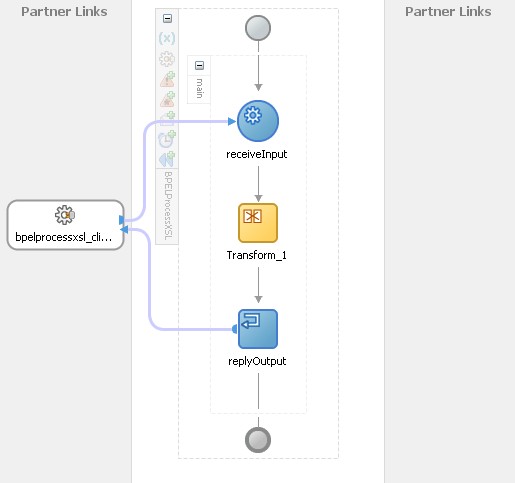
As one can see from the diagrams there is not much difference in the BPEL designer between the two examples and the decision on which technique to use would be based on factors which are different from company to company, but clearly use of the XSL mapper is an important factor.
The complete example application with SOA composite is available at http://sites.google.com/site/soastation/soastation_looselytyped_normalizer.zip

The Art of Agile Development

Keep this book to hand

The Art of Agile Development was recommended to me by Jeff McKenna when he provided some Scrum coaching to those of us in the Dublin office working on Oracle Social CRM. Back then it was a new, hot off the press book, but I have recently reread it because I have found it useful in providing guidance on what to watch out for when changing agile development practices. This was necessary due to changes in teams and technologies as some of us focused full time on Fusion Applications. Practices, roles and responsibilities we had gotten used to had to be adapted or dropped to blend in with APM, Oracle Fusion Application’s development methodology.

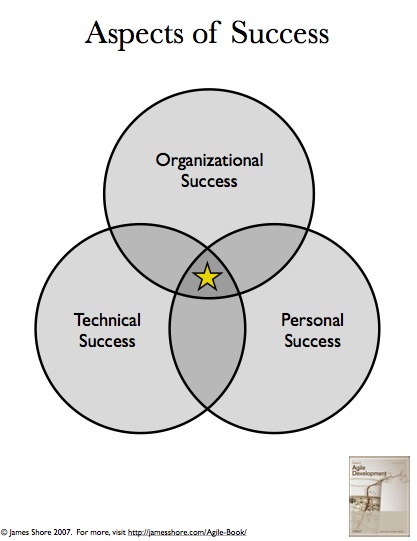
The book, by Shane Warden and James Shore, is a great introduction to agile development methodologies by covering both XP and scrum. Practical examples are generally from XP projects because that is where the authors have the greatest experience. The authors identify a broad set of practices that would be considered as characteristics of agile development methodologies in way or another. Recognising that it is very rare in most organisations to be able to follow an agile methodology completely as prescribed alternatives are mentioned, but not in every case. Shane and James are also very clear that many of these practices are often taking place at the same time in a software project rather than in a sequential waterfall methodology. However, categorising practices by what sort of activity and the nature of the activity give a very useful matrix for teams to analyse how agile their own practices are and perhaps identify areas where realistic improvements can be made. Just being able to have a label or term for a specific practice makes discussing within a group easier.

Download poster from James Shore

I see the collection of practices being grouped by phases (planning, analysis, design & coding, testing, deployment) and verbs (thinking, collaborating, releasing, planning, developing). For example, when team members are working on implementing a specific feature that kind of collaboration is ‘design & coding collaborating’ and the section in the book covers some pair programming techniques. In fact, this particular section addresses the misconception that pair programming is a fulltime ‘paired for life’ regime. It is a useful tool that can be used for a few hours a day to make some significant progress, reduce interruptions, and spread the knowledge of how and why parts of the system being developed work.

Other useful techniques peppered through the book include the Agility Self Assessment and the many skill development routines, which the authors called ‘etudes’. These are short exercises that may help in getting the feel for a more agile approach. When reading the chapters you might be thinking we don’t have the development experience to let team members do organic, incremental architecture design, or implement thorough automated testing. I wonder how many people never complete the book because they do not believe they can carry out these changes and deliver software in a timely fashion. It’s not until towards the end of the book that the authors address the reality of the mixed capabilities of the team. If this was at the beginning it might give the readers more staying power. The book does have some helpful advice on working with and around the politics, the mixture in experience levels, and heavy weight project management within your organisation. It has to be read in it’s entirety though and does make for an excellent reference book to dip in and out of.

This article has been edited since it was first published.

Should we ban anonymity on the Internet?

In an Information Security article a few months back, Bruce Schneier (author of Schneier on Security) and Marcus Ranum put some points forward for and against internet anonymity. I have to admit that I agree with Schneier and find Ranum’s argument quite weak. He appears to suggest that the main reason to enforce identity is to avoid spam. The tools aren’t great, but there are already mechanisms in place to address this. Criminals are always getting better at finding ways to exploit weaknesses in internet technologies increasingly at the heart of the way we shop, interact, work, entertain and inform ourselves. We just have to keep up with the pace in the cat and mouse game. Sacrificing anonymity, and the right to privacy, is too great a cost for just avoiding emails about Viagra ™ and Nigerian generals with a stash of cash to move out of the country.

What is the great danger of not being anonymous? Well it’s all the inferring that goes on about facts that get gathered around the things you search for, shop for, chat about, view and listen to. These are then used to categorise you for advertising, inclusion or exclusion from groups or activities. NetFlix provided a great example of this last year. Just weeks after the contest began, two University of Texas researchers showed that with the NetFlix data one could identify users and in some cases their political leanings and sexual orientation.

Getting back to Schneier’s point, trying to implement a robust identification system, which criminals can not outwit or take advantage of, is not possible…

Mandating universal identity and attribution is the wrong goal. Accept that there will always be anonymous speech on the Internet. Accept that you’ll never truly know where a packet came from. Work on the problems you can solve: software that’s secure in the face of whatever packet it receives, identification systems that are secure enough in the face of the risks. We can do far better at these things than we’re doing, and they’ll do more to improve security than trying to fix insoluble problems.