Oracle REST Data Services (ORDS) provides a powerful way to expose Oracle databases via REST, what if you could extend this capability to databases like DB/2, MySQL, PostgreSQL, and SQL Server—without installing ORDS on each database? In summary, your applications can interact with multiple databases, because a universal RESTful interface can streamline access and reduce development complexity.
Find out more and see the custom code in action!
As an extensible product where you can develop your own plugins, you can code your own ORDS JDBC AutoREST Plugin. To learn more about plugins in ORDS see: Crafting your ORDS plugin the Maven way
What is the ORDS JDBC AutoREST Plugin?
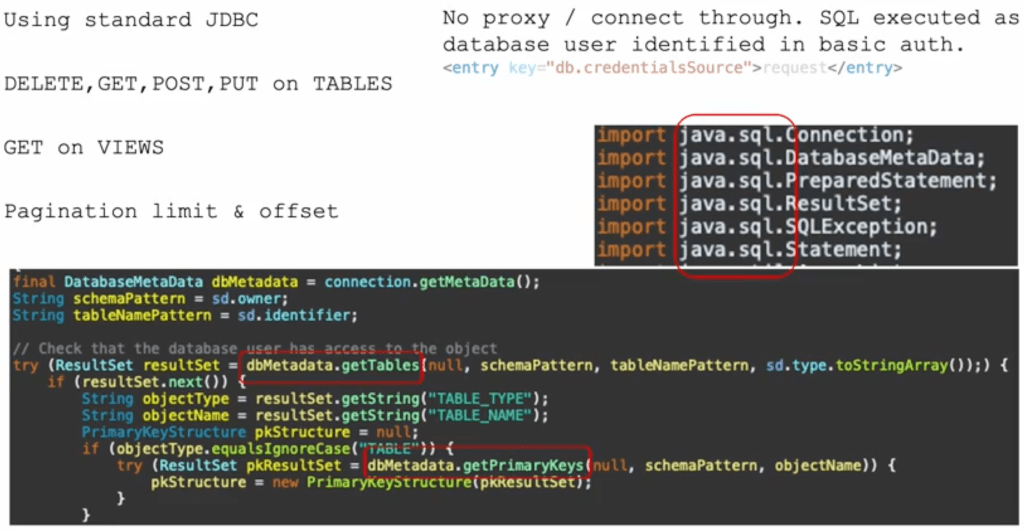
The ORDS JDBC AutoREST Plugin is a custom plugin for Oracle REST Data Services that enables RESTful access to a variety of relational databases. Using standard JDBC, it acts as a bridge between ORDS and databases beyond Oracle, providing a unified API layer.
Key Features
Multi-Database Support: Works with DB/2, MySQL, Oracle, PostgreSQL, and SQL Server.
Standard JDBC: Uses JDBC drivers to communicate with target databases.
No ORDS Installation Required: The target database does not need an ORDS installation.
RESTful Interface: Automatically generates REST endpoints for CRUD operations.
API Driven: The service definition metadata is in an OpenAPIV3 document which is reloaded every 5 minutes. Changes are picked up without a restart.
How It Works
Architecture Overview
The plugin integrates with ORDS and utilizes JDBC to interact with databases. ORDS remains the entry point, processing RESTful requests and translating them into SQL queries executed via JDBC connections.
A client sends a REST request to ORDS.
ORDS uses the basic authentication credentials to make a JDBC connection to the target database.
The ORDS JDBC AutoREST Plugin reads the API document that describes the database objects and services. It then generates the SQL statement and executes it over JDBC.
The database processes the request and returns results.
ORDS formats and sends back the response.
Subtle difference from ORDS AutoREST:
No installation required in the database
No HATEOS links generated
Only basic authentication
Of course, since you are building your own custom plugin, you can code any additional functionality you want.
Uses standard JDBC classes. No vendor specific code references.
Example Usage
Once configured, the plugin enables RESTful endpoints that map to database tables and views. For instance, a request to:
GET /autorest/employees/
Could return JSON data from an employees table, regardless of whether the underlying database is Oracle, MySQL, PostgreSQL, etc. Note that a HTTP request will require basic authentication with credentials for a database user and that user must have access to the underlying data.
Setting Up the Plugin
Prerequisites
Oracle REST Data Services (ORDS) installed and running.
JDBC drivers for the target databases.
Installation Steps
Clone the repository:git clone https://github.com/pobalopalous/ords-jdbc-autorest.git
Build the plugin and deploy it into your ORDS instance.
Configure database connections using JDBC connection strings.
Update the API document for your database to target tables or views.
Using x-autorest extension
An extension called x-autorest is used in the API document to define what tables and views are to be available, as well as what operations ( DELETE, GET, PUT, POST ) are permitted. Note that this requires that tables are defined with a primary key.
The REST service path can be an alias for the database object.For databases that use the concept of an object owner, it can be specified here.
A description of the x-autorest extension.
x-autorest:
  owner: DB2INST1 // Database user that owns the object
  identifier: INVENTORY // The database object
  type: table // The type of object table or view
Benefits & Use Cases
Why Use This Plugin?
Simplified API Development: Unified RESTful API for multiple databases.
Reduced Overhead: No need to install ORDS on every database.
Flexible Database Integration: Easily switch between databases without major application changes.
Ideal Use Cases
Multi-database applications needing a standardized REST API.
Data migration projects requiring uniform RESTful access.
Reporting and analytics tools aggregating data from multiple sources.
Conclusion
The ORDS JDBC AutoREST Plugin provides a powerful way to extend RESTful database access beyond Oracle to DB/2, MySQL, PostgreSQL, and SQL Server. With minimal setup and configuration, developers can use ORDS to expose database resources through a standard REST API, ensuring reliability without needing to install ORDS on each target database.
Explore the source code and start using it today: GitHub Repository.
One of the big announcements this month was the Oracle Database Service for Microsoft Azure. With this new fully managed service, Azure customers can seamlessly build Azure applications using the high-performance, high-availability, and automated management of Oracle Database services such as Autonomous Database running on OCI. Did you know that even before this announcement you could have a REST interface to Azure SQL through ORDS?
In this article I’ll show you how I have data from a hosted Azure SQL database used in an APEX application all made possible through ORDS. Although I’m using released products it is important to point out that using ORDS with SQL Server is not officially supported. Therefore, although you can use this approach, you mind find a use case that does not work. For example, an unsupported column data type.
This is your goal, sample data from Azure SQL rendered in an APEX application
Azure SQL Sample Database
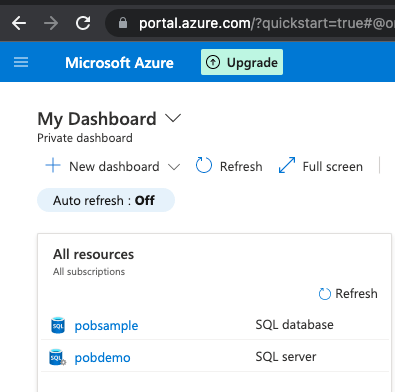
To get started, if you do not have an Azure SQL database already, head over to https://portal.azure.com/ and set yours up. By default you will get a functional, but empty database. In my case, I selected Sample for Use existing data option in the Additional Settings section of the create database sequence so that I had some data in place.
Create your database with sample data
SQL Server and Database
The overall process from zero involves creating an SQL Server ( pobdemo in my case ) and an SQL Database ( pobsample in my case ) which can be accessed outside of Azure.
You will also need to create some logins and users to access the database so Azure Data Studio, or some other client for working with Azure SQL will be needed. The administrator user should not be used for anything more than managing the database.
One login will be used by ORDS to verify the pool connection configuration. It does not require any specific privileges in the database just the ability to make a connection over JDBC. The login could be any value but for consistency we’ll call it ORDS_PUBLIC_USER
CREATE LOGIN ORDS_PUBLIC_USER WITH PASSWORD = '< keep this secret >';
The other login and database user is for the account that will be used to interact with the database. In this example: ords_demo
CREATE LOGIN ords_demo WITH PASSWORD = '< keep this secret >';
CREATE USER ords_demo FROM LOGIN ords_demo;
ALTER ROLE db_datareader ADD MEMBER [ords_demo];
ALTER ROLE db_datawriter ADD MEMBER [ords_demo];
Configure ORDS
Now that we have our database accounts let’s configure ORDS. In my case I already have an ORDS instance setup with the default pool configured for my Oracle 19c database and APEX is installed.
The directory that I extracted the ORDS 22.2.0 distribution to is ~/Downloads/ords-22.2.0.172.1758/ and the configuration directory is ~/Documents/Personal/azure_sql/. That directory looks like this:
The configuration for the azure_sql pool was achieved as follows while the configuration directory is the working directory. Note that you will need to know your JDBC connection string from your Azure Dashboard. You’ll find that under Show database connection strings.
See the ‘Show database connection strings’ to get your JDBC connection string
Armed with that information it is time to configure your azure_sql pool:
~/Downloads/ords-22.2.0.172.1758/bin/ords config --db-pool azure_sql set db.connectionType customurl

~/Downloads/ords-22.2.0.172.1758/bin/ords config --db-pool azure_sql set db.customURL jdbc:sqlserver://<rest of the JDBC connection string from Azure dashboard>

~/Downloads/ords-22.2.0.172.1758/bin/ords config --db-pool azure_sql set jdbc.driverName com.microsoft.sqlserver.jdbc.SQLServerDriver

~/Downloads/ords-22.2.0.172.1758/bin/ords config --db-pool azure_sql set db.credentialsSource request

~/Downloads/ords-22.2.0.172.1758/bin/ords config --db-pool azure_sql set restEnabledSql.active true

~/Downloads/ords-22.2.0.172.1758/bin/ords config --db-pool azure_sql set db.username ORDS_PUBLIC_USER
Every command entry should show a message confirming that the setting was applied. Now to set the password for ORDS_PUBLIC_USER. That should be treated as a secret:
~/Downloads/ords-22.2.0.172.1758/bin/ords config --db-pool azure_sql secret db.password

Enter the database password:
Confirm password:
The setting named: db.password was set to: ****** in configuration: azure_sql
When done, assuming that you are using the same pool name, your databases/azure_sql/pool.xml should look like this but without the comments:
<?xml version="1.0" encoding="UTF-8" standalone="no"?>
<!DOCTYPE properties SYSTEM "http://java.sun.com/dtd/properties.dtd">
<properties>
<comment>Saved on Fri Oct 11 11:21:28 IST 2019</comment>
<entry key="db.connectionType">customurl</entry>
<entry key="db.customURL">jdbc:sqlserver://your_sql_server.database.windows.net:1433;database=your_sql_db;encrypt=true;trustServerCertificate=false;hostNameInCertificate=*.database.windows.net;loginTimeout=30;</entry>
<entry key="jdbc.driverName">com.microsoft.sqlserver.jdbc.SQLServerDriver</entry>
<!-- username for account required to verify pool connection details are
correct. User does not require special privileges -->
<entry key="db.username">ORDS_PUBLIC_USER</entry>
<!-- Credentials in the request will be used to create injected DB connection
and ORDS Role will be SQL Developer. Authentication mode will be ANY_SCHEMA -->
<entry key="db.credentialsSource">request</entry>
<!-- REST Enabled SQL must be enabled -->
<entry key="restEnabledSql.active">true</entry>
</properties>
One of the settings is the JDBC driver to use ( jdbc.driverName ) and that is com.microsoft.sqlserver.jdbc.SQLServerDriver but ORDS does not ship with that JDBC driver. Download the SQL Server JDBC driver and copy the Java 11 jar into the ORDS lib/ext directory. In my case that is ~/Downloads/ords-22.2.0.172.1758/lib/ext
Time to startup ORDS in standalone mode and verify the connection pool is loaded correctly.
~/Downloads/ords-22.2.0.172.1758/bin/ords serve

ORDS: Release 22.2 Production on Fri Jul 29 13:52:06 2022

Copyright (c) 2010, 2022, Oracle.
...
2022-07-29T13:52:10.561Z INFO        Configuration properties for: |azure_sql|lo|
gopherProxySet=false
awt.toolkit=sun.lwawt.macosx.LWCToolkit
java.specification.version=11
...
2022-07-29T13:52:45.126Z INFO        Oracle REST Data Services initialized
Oracle REST Data Services version : 22.2.0.r1721758
Oracle REST Data Services server info: jetty/9.4.46.v20220331
Oracle REST Data Services java info: Java HotSpot(TM) 64-Bit Server VM 11.0.13+10-LTS-370
Test REST Enabled SQL
If you have gotten this far without errors that means ORDS can connect to the Azure SQL database using the db.username account and therefore the custom connection aspect of the pool configuration is correct. Now to confirm the REST Enabled SQL can use that pool configuration to access the database with basic authentication credentials provided. For that we’ll use the login that is a user in the database and cURL to submit a GET request
curl -u ords_demo http://localhost:8080/ords/azure_sql/_/sql
Enter host password for user 'ords_demo': ********
{
 "database_product_name":"Microsoft SQL Server",
 "database_product_version":"12.00.312",
 "database_major_version":12,
 "database_minor_version":0,
 "env":{"defaultTimeZone":"UTC","ordsVersion":"22.2.0.r1721758"}
}
We could just stop here and just use REST Enabled SQL directly with our Azure SQL database but let’s do something really interesting with APEX, which is probably why you’re here. First, a few words about how APEX works with SQL Server natively: it does not.
SQL Server Syntax
APEX has powerful support for consuming data over REST services including the ability to construct queries for Oracle and MySQL which are executed through ORDS REST Enabled SQL. This allows for a very dynamic no code approach to developing applications. See previous article How to use the Oracle Database Tools Service to provide MySQL data to APEX on this topic.
APEX does not provide the same level of support for SQL Server. Although one can configure an ORDS pool so that REST Enabled SQL can be used, APEX will not recognise the database type when you try create the REST Enabled SQL reference. All is not lost though. The work around is to write ORDS REST Services which have the specific SQL Server statements. Those services make the REST Enabled SQL calls and return the response. They are effectively custom wrapper services.
APEX calls custom ORDS Service which calls ORDS REST Enabled SQL which talks to Azure SQL
Now, on with the APEX adventure…
APEX Workspace
In my local Oracle database I have APEX installed and have created a workspace called AZURE which is using the AZURE database schema. That schema has been REST Enabled too.
The ‘azure’ workspace is in the ‘AZURE’ schema and that schema is REST Enabled
This AZURE database schema in the Oracle database will have the REST Services ( module/template/handler ) defined and those services will make the REST Enabled SQL calls. For convenience these services are not secured but obviously should be if they are to be used in a real world scenario. What is secured is the REST Enabled SQL endpoint. A username and password for the database user in Azure SQL must be provided but rather than having that in plain text in the handler source we’ll use an APEX Web Credential that the AZURE schema will have access to.
APEX Web Credentials
Web Credentials are a really useful feature in APEX that allows you to store authentication credentials for external REST services or REST Enabled SQL services. We’ll use that in our ORDS Service handler pl/sql block but more on that later. First, let’s define a Web Credential in the workspace.
Web Credential with Azure SQL username and password
There are a few things to highlight about the above Credentials for Azure
The Static Identifier is Credentials_for_Azure – we will refer to that later in the ORDS handler
The Authentication Type is Basic Authentication – the REST Enabled SQL endpoint uses this Authentication Type
The Valid for URLs specifies host.docker.internal as the server address. Remember how I said that Oracle 19c database was running in docker? Localhost would just point to the running container in my case. This is how the database can address the host machine ( my laptop ) which is running ORDS.
Stating the obvious here but it’s significant that you can change the username and password in the Web Credential without modifying the handler. Just thought I’d mention that.
And now with the Web Credential in place lets define the services in the AZURE schema that will submit SQL queries over REST Enabled SQL to Azure SQL database.
Wrapper Services
We’re going to define two services which follow this pattern: send a query, return the response. This relies on the APEX_WEB_SERVICE.MAKE_REST_REQUEST function to create the POST request, with Content-Type application/sql, and return the payload response. The previously defined Web Credentials are used to authenticate those requests.
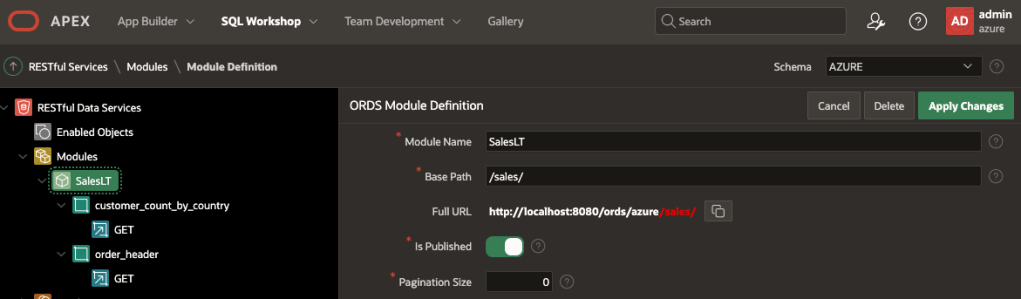
The module, templates and handlers can be defined in APEX or SQL Developer Web. One module with Base Path/sales/ along with two templates: customer_count_by_country and order_header.
One module with /sales/ Base Path and two templatesOf course the ORDS REST Services can be edited in SQL Developer Web too
Handler for /sales/customer_count_by_country
This handler executes an aggregation query to get the number of customers with a Main Office in each country.
DECLARE
  l_clob    CLOB;
  l_result  VARCHAR2(32767);
BEGIN
  APEX_WEB_SERVICE.g_request_headers.delete();
  APEX_WEB_SERVICE.g_request_headers(1).name := 'Content-Type';
  APEX_WEB_SERVICE.g_request_headers(1).value := 'application/sql';

  l_clob := APEX_WEB_SERVICE.make_rest_request(
    p_url         => 'http://host.docker.internal:8080/ords/azure_sql/_/sql',
    p_http_method => 'POST',
    p_credential_static_id => 'Credentials_for_Azure',
    p_body => 'select address.CountryRegion, count(CustomerAddress.CustomerID) as "CustomerCount"
from SalesLT.Address, SalesLt.CustomerAddress
where CustomerAddress.AddressID = Address.AddressID and CustomerAddress.AddressType = ''Main Office''
group by address.CountryRegion'
  );

HTP.print(l_clob);

END;
Handler for /sales/order_header
This handler executes a basic query to get all records from the SalesOrderHeader table.
DECLARE
  l_clob    CLOB;
  l_result  VARCHAR2(32767);
BEGIN
  APEX_WEB_SERVICE.g_request_headers.delete();
  APEX_WEB_SERVICE.g_request_headers(1).name := 'Content-Type';
  APEX_WEB_SERVICE.g_request_headers(1).value := 'application/sql';
  -- Get the XML response from the web service.
  l_clob := APEX_WEB_SERVICE.make_rest_request(
    p_url         => 'http://host.docker.internal:8080/ords/azure_sql/_/sql',
    p_http_method => 'POST',
    p_credential_static_id => 'Credentials_for_Azure',
    p_body => 'SELECT * FROM [SalesLT].[SalesOrderHeader]'
  );
  HTP.print(l_clob);
END;
Service Handler Walkthrough
Keep in mind that these handlers execute in the AZURE database schema which is the schema for the APEX Workspace we’ll create the Data Source references and APEX Application in. Both handlers follow these steps:
Set the Content-Type header to application/sql
Make a POST request with Web Credentials for authentication and a query
Write the REST Enabled SQL result to the HTTP Response stream.
There’s no validation on the response, or parsing that response to change the structure. We’ll leave it to APEX to figure out how to parse the response payload.
Now is it a good time to verify that the two handlers work. We can invoke them through cURL. Remember the schema alias is azure, the module base path is /sales/ so the URL will begin with http://localhost:8080/ords/azure/sales/
Now is a good time to reiterate that the ORDS REST Services are not protected and if the Azure SQL database you’re connecting to had any sensitive data it should be protected but that’s not the focus of this article.
As you can see from the above tests, these are REST Enabled SQL responses with lots of information about the statement executed, the metadata of the columns when all we’re really interested in is the data at items.resultSet.items. That will be relevant when we look into Data Sources.
APEX Data Sources
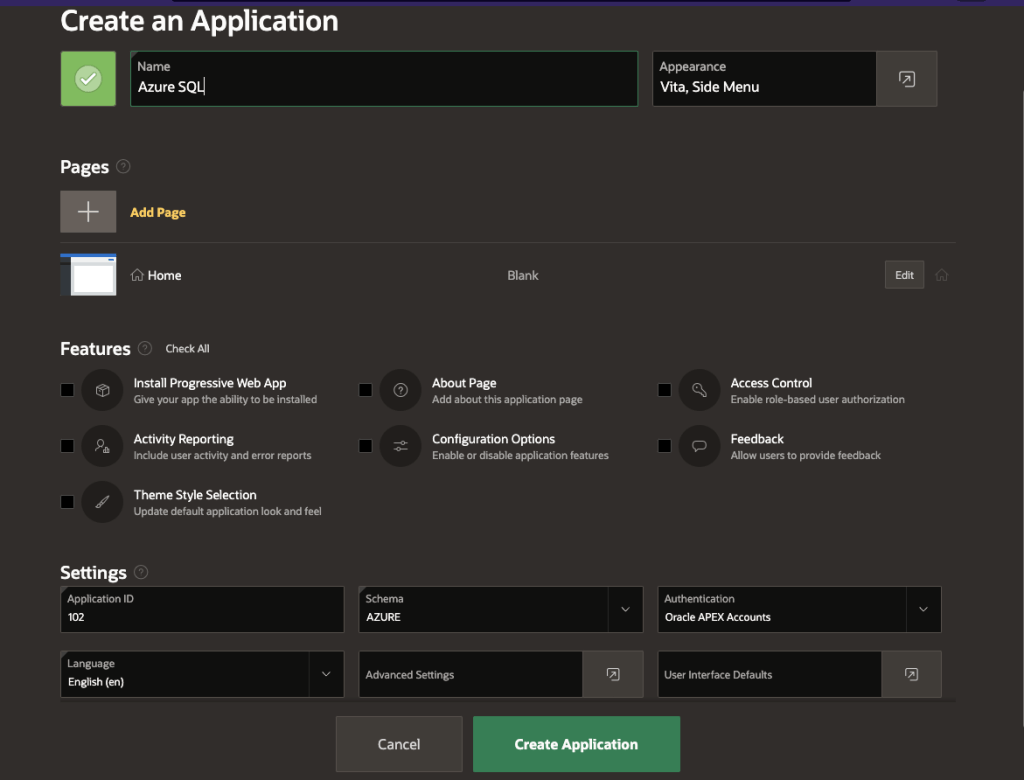
Let’s create a basic APEX application called Azure SQL with just the defaults.
Basic application with a Home page
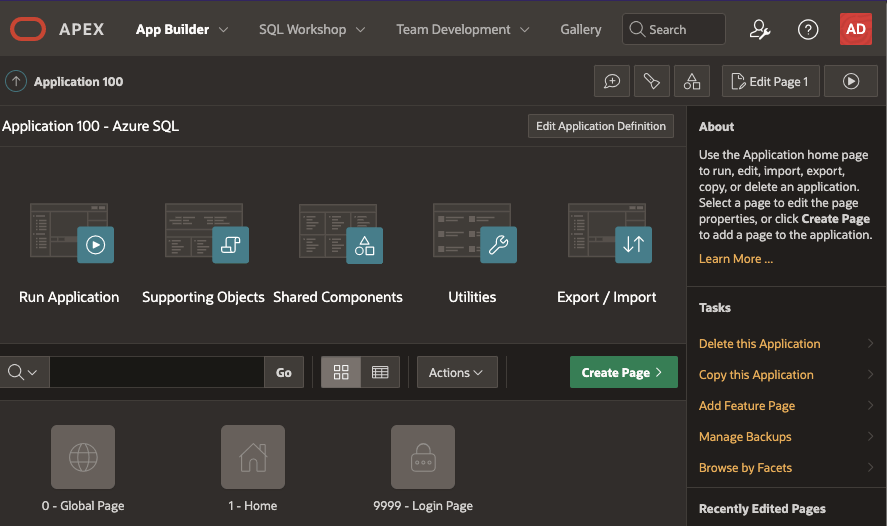
Once created, edit the application and navigate to the Shared Components section.
Shared Components is where Data Source references can be defined
The Data Source references section has various options for getting data over REST.
Data Sources section has lots of options
Define REST Data Sources for both endpoints but specify their REST Data Source Type as Simple HTTP.
Note the URL has host.docker.internal has the server name because the Oracle database is running in Docker
Remember how the REST Enabled SQL response structure contains lots of metadata? For Data Profile specify the Row Selector as items.resultSet.items so that APEX can find the array of rows that it can interrogate for Data Profile.
The Row Selector must be specified to find the data in the response
Two Data Source references must be defined. In my case I also defined synchronisation for the AzureSalesHeader Data Source to pull in data to a local table. I’ll cover that in a separate article.
Data Source references that are Simple HTTP types
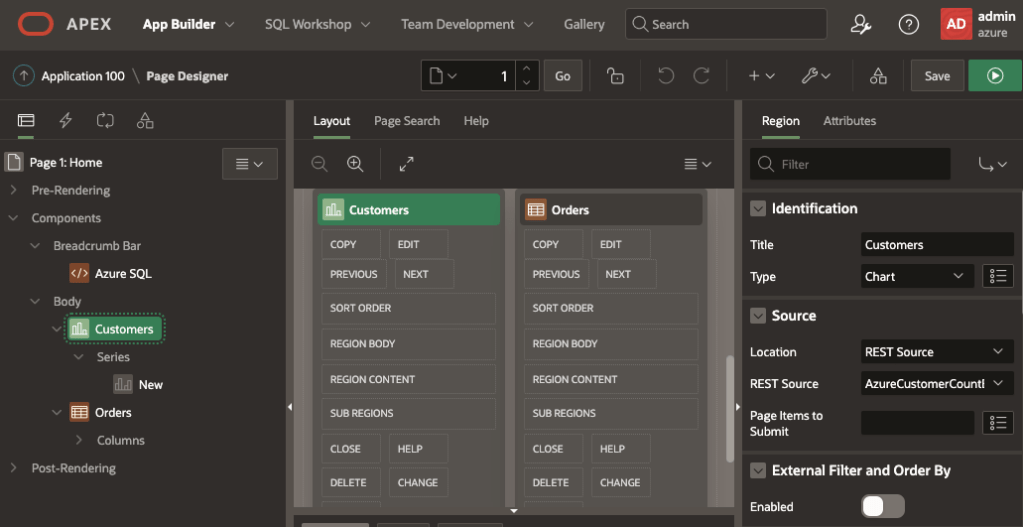
Now let’s put those to use. Edit the Home page and drop in a Chart and a Classic Report to the body. The Chart will use REST SourceAzureCustomerCountByCountry and the Classic Report will use REST SourceAzureSalesHeader.
Source for the components are REST Source
The Classic Report is very basic and includes the column list from the AzureSalesHeader Data Source. For the Customers chart the Series Source Location should be set to Region Source so that it inherits the source from the Chart and columns can be selected.
For the Chart series Source Location is Region Source and the Column Mapping for what to show
With all that in place, run the application to see the Home page with the Chart and Classic Report. Note that by following the default application setup a login is required. Just use the same workspace developer username and password.
Pie Chart and Classic Report with live data from Azure SQL
Conclusion
In theory ORDS REST Enabled SQL can be used with any database that you have a JDBC driver for which will run on Java 11. In practice, only Oracle RDBMS and Oracle Cloud MySQL is supported. Keeping that in mind, the capability of bringing in data from other databases, such as Azure SQL and using it in your APEX applications opens up a lot of integration possibilities.
What projects does this make possible for you now? I’d be really interested to hear about it.
In future articles I will cover synchronisation, joining local with remote data as well as going beyond just select statements.
Addendum to the original article…if you are looking for an approach that is supported you can create database links from Autonomous Database to Non-Oracle databases.













 Peter's Random Topic Library